Agenda
-
Problem
-
Historical Context
-
Tenure and Estates
-
Restraints on Alienation
-
Indigenous Land Rights and Treaty
-
Expropriation
Unit 2 Problem: Land Back by Bequest 🌳
-
Brainstorm
-
Historical Perspective
-
Legal analysis
Brainstorm: “Issue Spotting”
What legal issues can you “spot” in this problem? How would you describe those issues in your own words?
Historical Context
1763 to 1867
Royal Proclamation, 1763
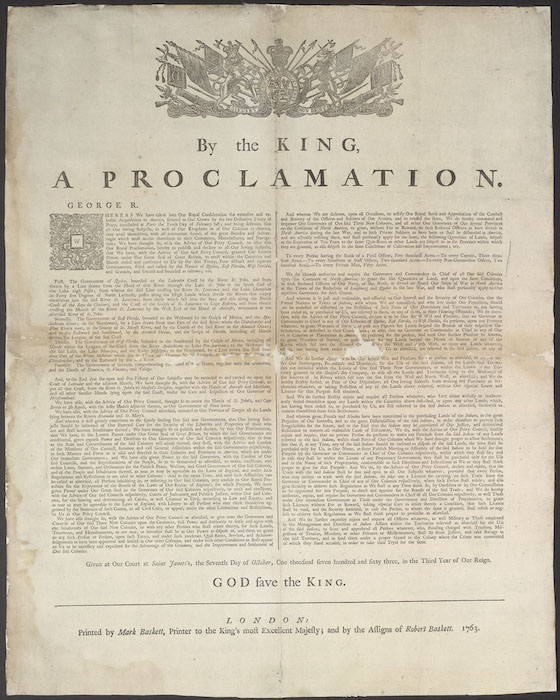
“…should not be molested or disturbed in the Possession of such Parts of Our Dominions and Territories as, not having been ceded to or purchased by Us, are reserved to them, or any of them, as their Hunting Grounds”
“…strictly enjoin and require, that no private Person do presume to make any purchase from the said Indians of any Lands reserved to the said Indians, within those parts of our Colonies where, We have thought proper to allow Settlement: but that, if at any Time any of the Said Indians should be inclined to dispose of the said Lands, the same shall be Purchased only for Us, in our Name, at some public Meeting or Assembly of the said Indians, to be held for that Purpose”
</div>
Royal Proclamation (1763)
What, if anything, does the Royal Proclamation say or imply about the source of Indigenous land rights recognized by the British Crown?
- Doctrine of preemption: Indigenous rights/title can only be transferred to the Crown
Settler colonialism through 19th Century treaty making
-
Treaty of Paris and the Royal Proclamation (1763)
-
Robinson Treaties (1850); numbered treaties (1871 - 1921)
-
Confederation (1867)
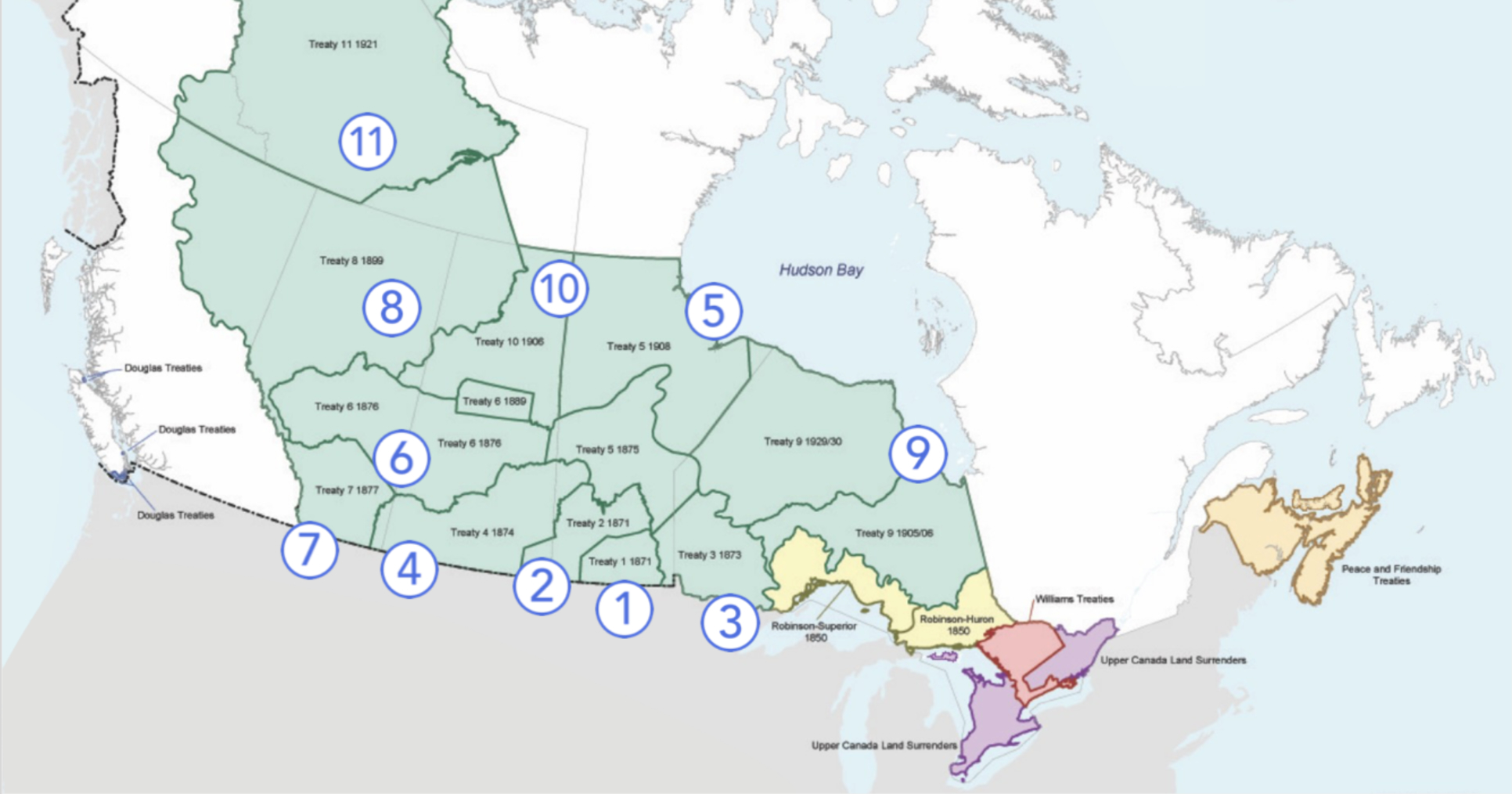
Key idea
Indigenous land rights from an Anglo-Canadian legal perspective underwent a transformation over this period (1763 - 1867) along with the rise of settler colonialism, from “title” to limited “rights of use”.
Feudal Land Tenure
Norman Conquest, 1066
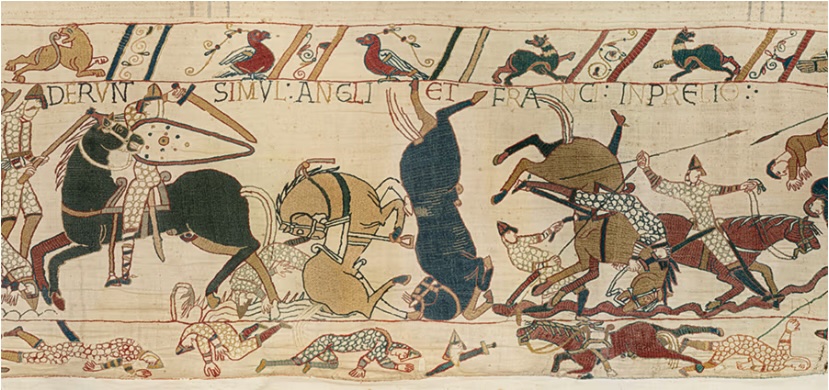
Feudal Land Tenure
Two key ideas:
-
All land “owned” by the king (radical or allodial title)
-
Privilege of tenure: property held “of the king”
Common Law Estates
Ownership of a legal interest in land, not ownership of land (e.g. fee simple estate).
Escheats Act, RSNS 1989, c 151
2 The Governor in Council may direct the Attorney General to take proceedings to revest in the Crown
(a) any lands comprised in any grant, or any part thereof, which have become forfeited to the Crown for non-fulfilment of the condition in the grant;
(b) any or all lands of persons dying intestate and leaving no heirs or persons entitled to the said lands under the laws of the Province.
Common Law Estates in Land
Some terms you’ll see in this unit:
-
Grant/Grantor/Grantee
-
Devise/Testator/Donee
Fee Simple
“Largest estate known to the common law”
“To A and her heirs.”
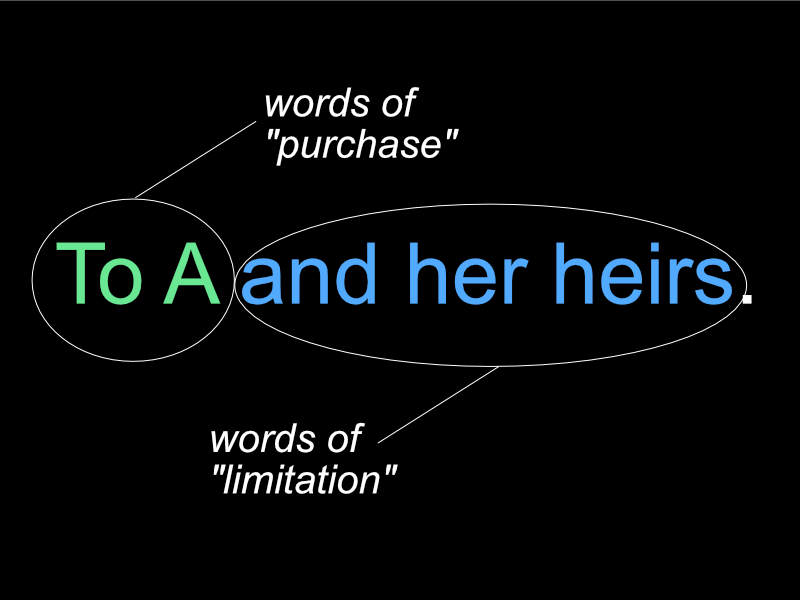
Fee Simple
-
X grants: “To A and her heirs”
-
X grants: “To A”
-
X grants: “To A in fee simple”
Traditionally, only the first of these examples was interpreted by courts as granting an estate in fee simple to A, but this position has changed under modern provincial statutes. Why?
Conveyancing Act, RSNS 1989, c 97
13 Except where a contrary intention appears by the conveyance,
(a) where words of limitation are not used, the conveyance conveys the whole property right that the party conveying had power to dispose of by the conveyance, including, in the case of real property, the fee simple;
Wills Act, RSNS 1989, c 505
27 Where any real property is devised to any person without any words of limitation, such devise shall be construed to pass the fee simple or the whole estate or interest which the testator had the power to dispose of by will in such real property, unless a contrary intention appears by the will.Life Estate
X grants: “To A for life”
Life Estate
X grants: “To A for life, then to B”
Life Estate
X grants: “To A for life, then to B for life, then to C”
A Puzzle?
X grants: “To A in fee simple, then to B.”
Re Walker, (1925) 56 OLR 517
“I give and devise unto my said wife all my real and personal property saving and excepting thereout as follows … and also should any portion of my estate still remain in the hands of my said wife at the time of decease undisposed of by her such remainder shall be divided follows …"
Re Walker: Prohibition on restraining alienation
“Where there is absolute ownership, that ownership confers upon the owner the rights of an owner and restrains an alienation; and similar attempts to mould and control the law are void”
“When a testator gives property to one, intending him to have all the rights incident to ownership, and adds to this a gift over of that which remains in specie at his death or at the death of that person, he is endeavouring to do that which is impossible. His intention is plain but it cannot be given effect to.”
Re Walker: Options for interpretation?
-
Fee simple (👍 claiming under Ellen Walker’s will)
-
Life estate + gift over (👍 claiming under John Walker’s will)
-
Is there a third option?
Re Walker: Interpretive principles
-
Construction of the will = intention of the testator
-
“The Court has then to endeavour to give such effect to the wishes of the testator as is legally possible, by ascertaining which part of the testamentary intention predominates and by giving effect to it, rejecting the subordinate intention as being repugnant to the dominant intention.”
Vested and Contingent Estates
Stuartburn (Municipality) v Kiansky
What interest in land does Mr. Kiansky hold? Why does the court say that this interest counts as “ownership” of land?
Vested interests (Stuartburn):
To A for life, then to K and their heirs
- A: vested in possession
- K: vested in interest
Contingent interests (vs vested)
To A for life, then to B when they turn 25 years of age.
- A: vested in possession
- B: contingent
Subject to divestment
To A and their heirs, until A turns 25 years of age, then to B.
Restraints on Alienation
Blackburn v McCallum
“I will that the aforesaid parcels of land shall not be at their disposal at any time until the end of twenty-five years from the date of my decease, and farther, I will that the said parcels of land shall remain free from all incumbrance, and that no debts contracted by my sons, William Chisholm and Hugh Chisholm, shall by any means incumber the same during twenty-five years from the date of my decease.”
In what way is the restraint on alienation at issue in Blackburn different than the restraint at issue in Re Walker?
When is a restraint on the alienation of a fee simple interest valid? When is it invalid?
“[To MTI,] which non-profit organization should be prohibited from transferring the land to any other party for a period of 50 years, after which said organization may only transfer it to another Mi’kmaq-led entity for no more than an amount of $500,000.”
Property and Canadian Federalism at Confederation
Disputes over property became the crucible in which a new, post-Confederation Canadian state forged core elements of its national character:
-
Relations with Indigenous peoples as a settler colonial state (St. Catherine’s Milling)
-
Economic foundations as a liberal market society driven by natural resource extraction (McLaren v Caldwell)
St. Catherine’s Milling
Below is a graphic representation of the legal positions of Ontario and Canada.
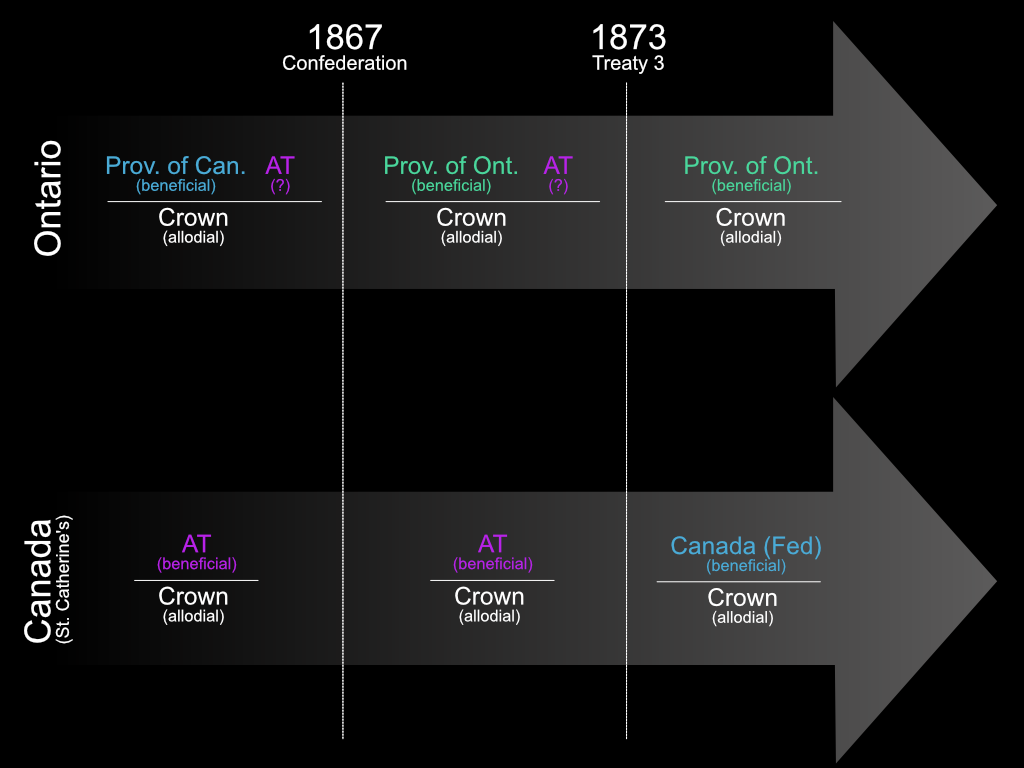
Two Key Questions
How do the courts in St. Catherine’s Milling answer these questions:
-
What is the source of Indigenous rights in land?
-
What is the content of these rights?
How did the Privy Council in St. Catherine’s Milling reach such a “thin” view of Indigenous land rights and title? What biases, assumptions, and legal principles allowed them to conclude that Indigenous interests were at most “personal and usufructory” rights?
Terra Nullius
“Territory without a master”: the 19th century justification for the Crown’s claims to sovereignty and title.
-
Terra nullius underpinned the doctrine of discovery: if Indigenous peoples’ lands were “legally vacant”, these lands could be “discovered” by the British and the assertion of sovereignty and title could be made without conquest or cession. This view requires a “discriminatory denigration” of Indigenous peoples, laws and other forms of social organization and practices.
-
Discovery was never “perfected” in British North America, where its application came to be understood as the Crown’s acquisition of a pre-emptive right to acquire Indigenous title/ownership (Johnson v McIntosh; RP1763)–thereby underscoring the contradiction of viewing Indigenous lands as “legally vacant”.
-
In St. Catherine’s Milling, the assumptions underlying terra nullius were extended further to deny that Indigenous nations held any true title to their lands at “discovery”; nevertheless the Crown’s pre-emptive right could be exercised to remove the “burden” of Indigenous rights in land through cession or purchase.
Revisiting Locke
How does Locke’s theory of possession become a justification for terra nullius in the era of settler colonialism? Where can you find evidence of this?
R v Syliboy
How do the principles and assumptions from the St. Catherine’s Milling case drive Justice Patterson’s refusal to recognize Mi’kmaw treaty rights in Syliboy?
Land Back
“Do you think a bequest of this nature (in our hypothetical problem) addresses the harms of settler colonialism advanced by the St. Catherine’s Milling decision and its aftermath?”
Black Settlement in Nova Scotia
(1783 - 1815)
In what ways did British practices of land grants to Black settlers (Loyalists, Maroons and refugees) reflect emerging legal characterizations of Indigenous title at the time? Are there parallels or alliances between contemporary calls for land justice for African Nova Scotian communities and for Indigenous peoples? What differences are important to recognize here?
Expropriation of Property:
Eminent Domain
Class Poll: Expropriation
Room name: BAXTERDAL
Riparian Rights
-
Non-navigable: riparian owner owns the riverbed (and therefore the right to use the watercourse) to the centre-line of the river: ad medium filum aquae
-
Navigable: if river is navigable in fact, then there is a public right to navigation; title to the beds of these rivers is vested in the Crown
McLaren v Caldwell - In the Courts
-
1847/52 - Ontario passes legislation re rivers and streams
-
1863 - Boale v Dickson: gives Ontario legislation restrictive interpretation
-
1880 - Chancery Court upholds Boale and grants McLaren an injunction
-
1881 - Ontario Court of Appeal overturns Boale
-
1882 - Supreme Court of Canada reinstates Boale and restores Mclaren’s injunction
-
1884 - JCPC overturns SCC decision (but on federalism grounds)
McLaren v Caldwell - In the Federal Parliament
-
After Chancery decision, Ontario Legislature (Liberal) enacts Rivers and Stream Act (1881).
-
Federal Parliament (Conservative) disallows Rivers and Streams Act several times
Interpretation of statutes affecting property
How does the Ontario Court of Appeal interpret the provincial legislation at issue in McLaren v Caldwell?
What principle of statutory interpretation does Ritchie C.J., writing for the Supreme Court, use? What is the rationale offered for this principle?
Legal Basis for Compensation (McLaren v Caldwell)
Why, according to the federal Conservatives, should Ontario be required to pay compensation for “taking” McLaren’s property by enacting the Rivers and Steams Act (1881)? On what legal basis?
Expropriation Act, RSNS 1989, c 156
3(1)(c) “expropriate” means the taking of land without the consent of the owner by an expropriating authority in the exercise of its statutory powers;
[…]
24 Where land is expropriated, the statutory authority shall pay the owner compensation as is determined in accordance with this Act.
Perry v Clissold
“It cannot be disputed that a person in possession of land in the assumed character of owner and exercising peaceably the ordinary rights of ownership has a perfectly good title against all the world but the rightful owner.”
(per Lord Macnaghten)
How do we know when government action short of acquiring title amounts to a compensable “taking” of property?
Pennsylvania Coal Co. v Mahon: is U.S. state regulation that prevents coal mining when it would cause subsidence an “uncompensated taking”?
Possession, Rule of Capture, and the 19th Century Natural Resource Economy
-
As Canada pursues an economic program of resource extraction, legal rules about possession of wild animals become a key component of nation-building and national policy
-
Goals to promote fisheries and the development of other “open access resources” start to clash with worries about over-use of resources and the public means to regulate these activities
Clift v Kane; Frederick Gerring Jr. v R
How would you use Clift v Kane and The Frederick Gerring Jr. to revisit and revise your answer to our Unit 1 problem (Wowkwis)?
Does the “rule of capture” in these cases follow the decision in Pierson v Post? If not, how are they different?